Electric unicycle tire pressure
Pressure changes how an EUC rides more than any setting in the app — and a tire run too soft is the most common reason a wheel comes to us with a flat.
Updated 2026-10-23
1. Start from the sidewall, not from the internet
Every tire has a maximum pressure molded into the sidewall. Never go above it. Your wheel's manual gives the maker's recommended range; use that as the starting point, then tune for your weight and your riding.
2. Tune for weight and riding
- Heavier rider, more pressure. A soft tire under a heavy rider squashes, wanders and pinches the tube against the rim on a pothole.
- Street and range: firmer. Less rolling resistance, sharper steering, more miles per charge.
- Trails and gravel: softer, within the range. More grip and comfort; check it more often.
- Change it a few PSI at a time and ride the same route. Write down what you like.
3. Check it weekly
Tubes lose a few PSI a week. Check cold, before a ride, with a gauge you trust — the pumps with built-in gauges are often off by several PSI. Many riders use a car tire inflator with a digital readout.
4. Signs the pressure is wrong
- The wheel feels vague and wanders on camber: too soft.
- Every crack in the road comes through the pedals and the tire skips over bumps: too hard.
- The tire looks squashed at the bottom when you stand on the wheel: too soft for your weight.
When it is a bench job
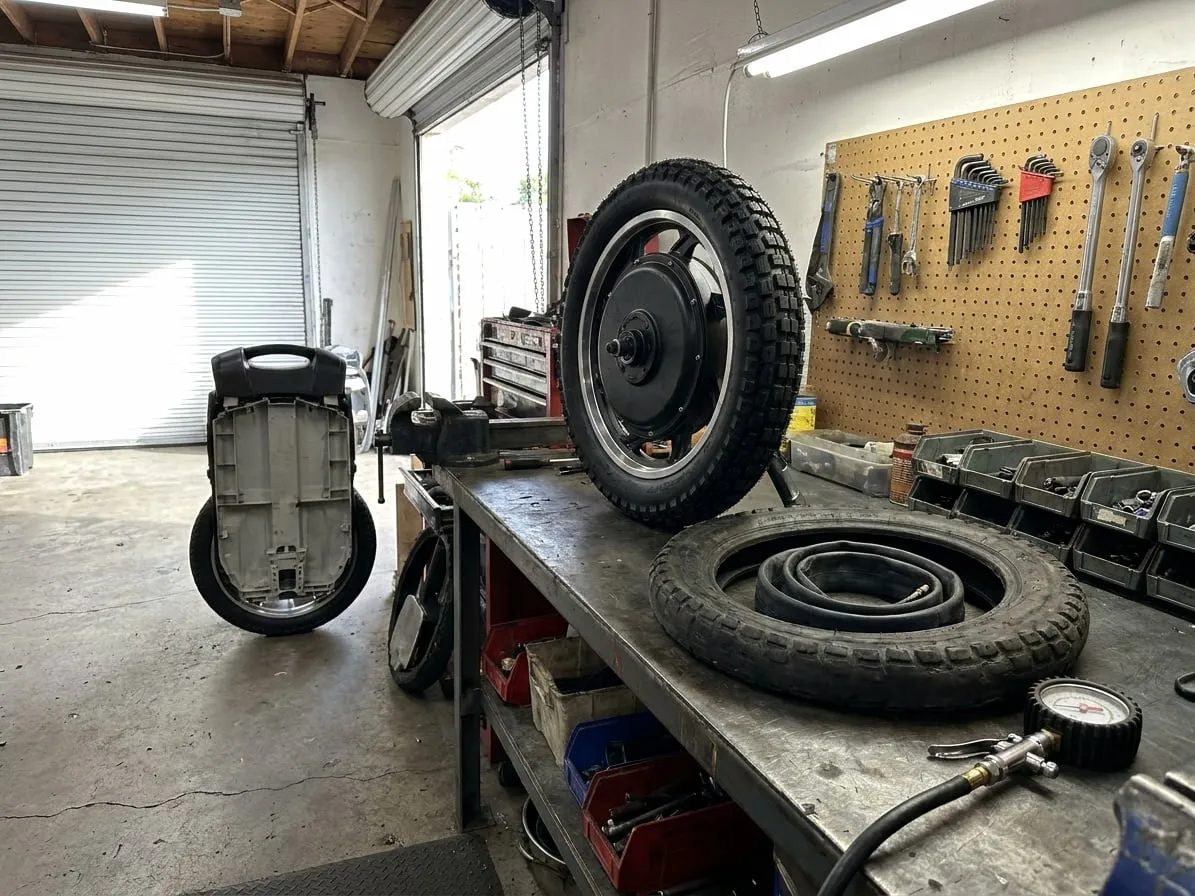
A tire that keeps losing pressure has a slow puncture or a valve failing at its base, and on most electric unicycles the motor has to come out to fix either. We change the tube or tire, find what caused the flat and set the pressure for your weight before the wheel goes back.
Tried all of that?
Then the fault is inside the wheel. We pick it up anywhere in Southern California, find the fault and quote it before any work — about a week from pickup to return.